



The use of fossil fuels, especially oil and gas, in recent years has accelerated and this triggers a global energy crisis. Renewable bioenergy is viewed as one of the ways to alleviate the current global warming crisis. Major efforts are devoted to developing alternative electricity production methods. New electricity production from renewable resources without a net carbon dioxide emission is much desired.
 Renewable Energy : Green Energy
A technology using microbial fuel cells (MFCs) that convert the energy stored in chemical bonds in organic compounds to electrical energy achieved through the catalytic reactions by microorganisms has generated considerable interests among academic researchers in recent years. Bacteria can be used in MFCs to generate electricity while accomplishing the biodegradation of organic matters or wastes. Fig. below shows a schematic diagram of a typical MFC for producing electricity. It consists of anodic and cathodic chambers partitioned by a proton exchange membrane (PEM).
Renewable Energy : Green Energy
A technology using microbial fuel cells (MFCs) that convert the energy stored in chemical bonds in organic compounds to electrical energy achieved through the catalytic reactions by microorganisms has generated considerable interests among academic researchers in recent years. Bacteria can be used in MFCs to generate electricity while accomplishing the biodegradation of organic matters or wastes. Fig. below shows a schematic diagram of a typical MFC for producing electricity. It consists of anodic and cathodic chambers partitioned by a proton exchange membrane (PEM).
Microbes in the anodic chamber of an MFC oxidize added substrates and generate electrons and protons in the process. Carbon dioxide is produced as an oxidation product. However, there is no net carbon emission because the carbon dioxide in the renewable biomass originally comes from the atmosphere in the photosynthesis process. Unlike in a direct combustion process, the electrons are absorbed by the anode and are transported to the cathode through an external circuit. After crossing a PEM or a salt bridge, the protons enter the cathodic chamber where they combine with oxygen to form water. Microbes in the anodic chamber extract electrons and protons in the dissimilative process of oxidizing organic substrates. Electric current generation is made possible by keeping microbes separated from oxygen or any other end terminal acceptor other than the anode and this requires an anaerobic anodic chamber.
Typical electrode reactions are shown below using acetate as an example substrate.
Anodic Reaction:
CH3COO- + 2H2O = 2CO2 + 7H+ + 8e-
Cathodic Reaction:
O2 + 4e- + 4H+ = 2H2O
The overall reaction is the break down of the substrate to carbon dioxide and water with a concomitant production of electricity as a by-product.
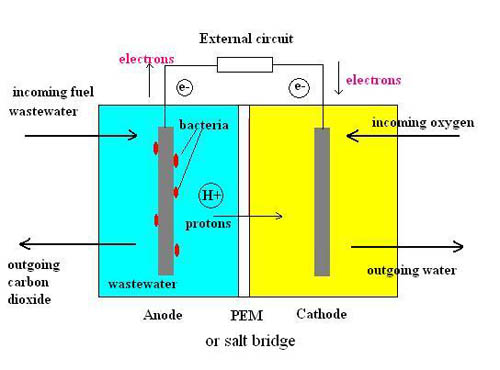 Mechanism of MFC
Based on the electrode reaction pair above, an MFC bioreactor can generate electricity from the electron flow from the anode to cathode in the external circuit.
Mechanism of MFC
Based on the electrode reaction pair above, an MFC bioreactor can generate electricity from the electron flow from the anode to cathode in the external circuit.
In recent years, rapid advances have been made in MFC research and the number of journal publications has increased sharply in the past three years with more researchers joining the research field. Several reviews on MFC are available, each with a different flavor or emphasis. Logan et al. (2006) reviewed MFC designs, characterizations and performances. The microbial metabolism in MFCs was reviewed by Rabaey and Verstraete (2005). Lovley (2006) mainly focused his review on the promising MFC systems known as Benthic Unattended Generators (BUGs) for powering remote-sensoring or monitoring devices from the angle of microbial physiologies. Pham et al. (2006) summarized the advantages and disadvantages of MFCs compared to the conventional anaerobic digestion technology for the production of biogas as renewable energy. Chang et al. (2006) discussed both the properties of electrochemically active bacteria used in mediator-less MFC and the rate limiting steps in electron transport. Bullen et al. (2006) compiled many experimental results on MFCs reported recently in their review on biofuel cells.
-
4th International MFC Conference

-
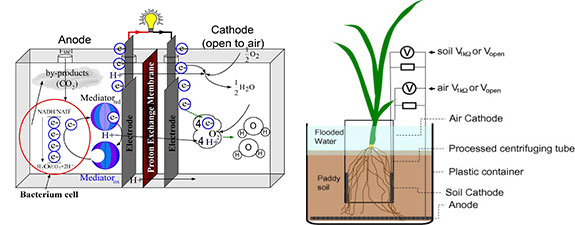
Different types of MFCs
-
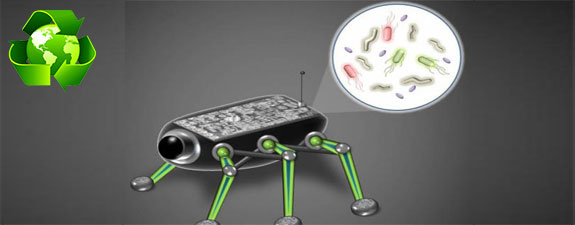
Robo Insect Using MFC for Power
-
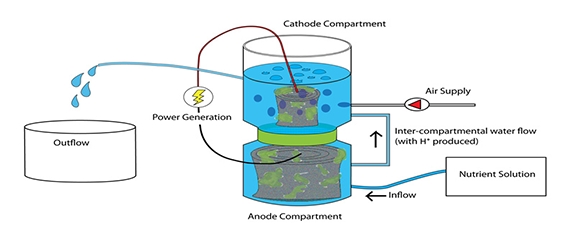
Schematic of MFCs
-
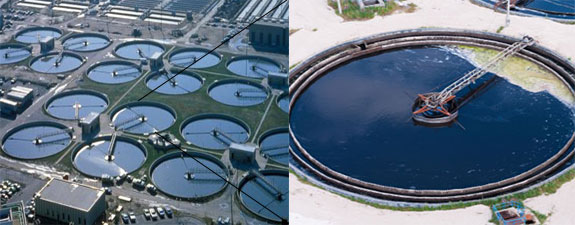
Waste Water Plant in Australia using MFCs
-
Search
- Themes
-
Share
-
-
Quick Links
Introduction




Copyright ©
Sunbeam Schools, Lahartara
Designed by Arfat Salman and Rishabh Jain